
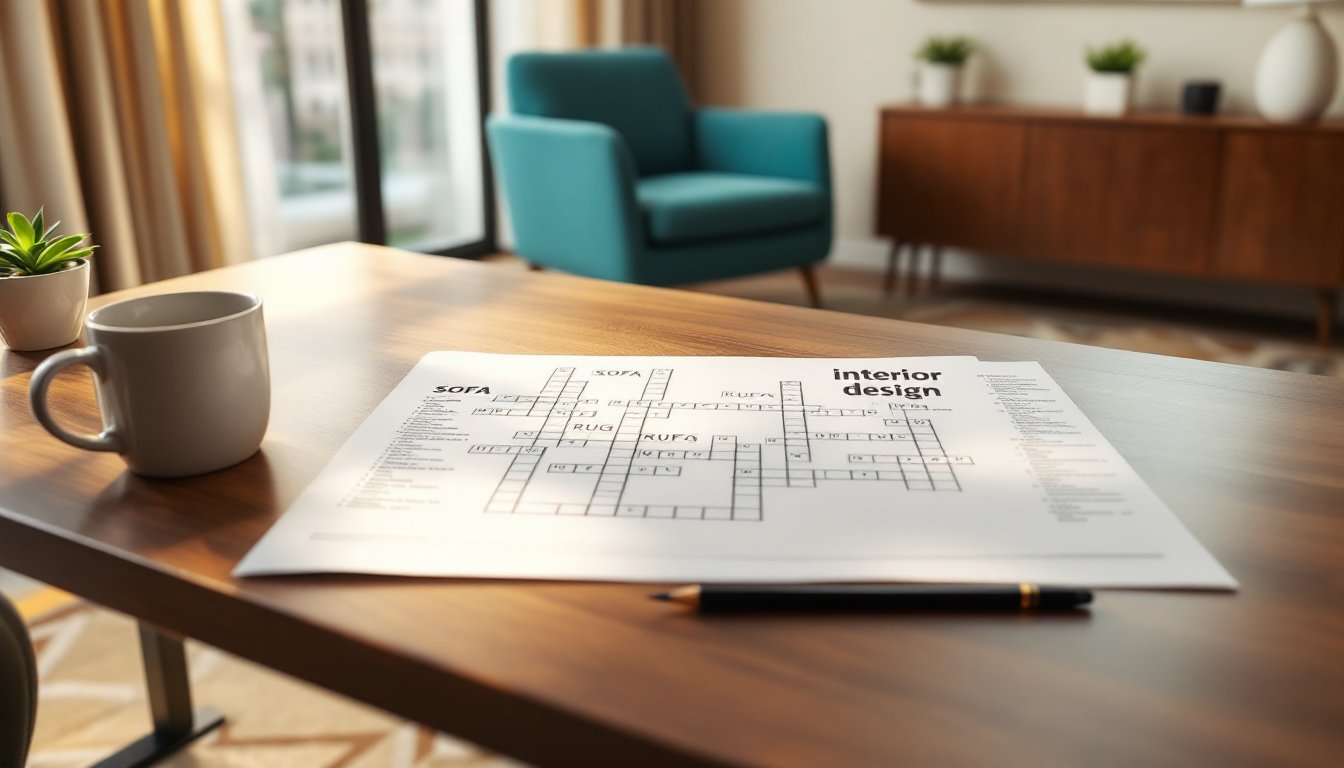

Crossword puzzles often reach into the vocabulary of home design, stumping solvers with clues about furniture, finishes, and room elements. Interior design crossword clues can range from simple three-letter fabric types to eight-letter architectural terms. Whether the puzzle asks for a window treatment, a flooring style, or a decorative accent, knowing the common answers helps fill grids faster. This guide breaks down the most frequent interior design crossword answers, organized by length and category, plus strategies for cracking tricky clues when the obvious answer doesn’t fit.
Key Takeaways
- Interior design crossword clues commonly reference furniture styles, architectural features, textiles, and decorative objects, often incorporating wordplay, abbreviations, or historical references.
- Short answers like RUG, LAMP, SOFA, and DECOR fill tight grid spaces, while longer interior design crossword answers such as OTTOMAN, PARQUET, and CREDENZA require more specific terminology.
- Paying attention to tense, plurality, abbreviations, and crossing answers helps narrow down the correct solution for design-related clues.
- Watch for era-specific hints—Victorian features suggest turret or gable, while Bauhaus principles point to form or function in interior design crossword puzzles.
- Color terms like BEIGE, TAUPE, and TEAL are crossword staples, and recognizing brand names turned generic (FORMICA, CORIAN, BERBER) can unlock trickier design clues.
- Material-based clues referencing countertops, flooring, or finishes often yield common answers like GRANITE, HARDWOOD, or MATTE depending on letter count and context.
Understanding Interior Design Crossword Clues
Crossword constructors pull interior design terms from several buckets: furniture styles, architectural features, textiles, color palettes, and decorative objects. Clues often play with wordplay, abbreviations, or historical references.
A clue reading “Art Deco feature” might point to chrome, neon, or inlay, depending on letter count. “Window dressing” typically means drape, shade, or valance. Some clues reference brand names that have become generic terms, formica for laminate countertops, for example, though most puzzles stick to common nouns.
Pay attention to tense and plurality. “Window coverings” suggests a plural answer, while “a window covering” points to singular. Abbreviations in the clue (“Fr.” for French, “Brit.” for British) hint at foreign terms like tapis (French for rug) or loo (British for bathroom, though that’s more plumbing than design).
Context from crossing answers helps narrow options. If the puzzle theme relates to historic homes, expect terms like wainscot, corbel, or newel. Modern design puzzles lean toward sleek, minimal, or loft.
Most Common Interior Design Crossword Answers
Short Answers (3-5 Letters)
Short answers appear most often because they fit tight grid spaces and offer high vowel counts.
RUG (3 letters): Clues include “Floor covering,” “Persian export,” or “Area ___.”
LAMP (4 letters): “Desk item,” “Shade holder,” or “Lighting fixture.”
SOFA (4 letters): “Couch,” “Sectional piece,” or “Living room staple.”
DESK (4 letters): “Study furniture,” “Workspace,” or “Secretary, e.g.”
TILE (4 letters): “Backsplash piece,” “Mosaic unit,” or “Bath surface.” Can refer to ceramic, porcelain, or natural stone.
EAMES (5 letters): “Iconic chair designer.” Charles and Ray Eames created mid-century furniture that appears frequently in design-focused puzzles.
DECOR (5 letters): “Room style,” “Interior design,” or “Aesthetic touches.”
SCONCE (6 letters): “Wall-mounted light,” often used in hallways or flanking mirrors. Can be hardwired or plug-in.
DRAPE (5 letters): “Window treatment,” heavier than a curtain, typically lined and pleated.
PLAID (5 letters): “Tartan pattern,” common in upholstery and throw pillows.
Medium Answers (6-8 Letters)
Medium-length answers allow constructors to use more specific terminology.
OTTOMAN (7 letters): “Footstool,” “Upholstered storage,” or “Cushioned seat.” Originally a low, cushioned bench: modern versions often include hidden storage.
PARQUET (7 letters): “Geometric flooring,” “Wood tile pattern.” Refers to small wood pieces arranged in repeating geometric designs, popular in pre-war apartments and formal dining rooms.
VALANCE (7 letters): “Short curtain,” “Window topper.” Hangs across the top of a window to hide hardware or add decorative interest, typically 12–18 inches tall.
LINENS (6 letters): “Bedding,” “Table coverings,” or “Fabric goods.” Encompasses sheets, tablecloths, and napkins, though not always literal linen fiber.
CREDENZA (8 letters): “Sideboard,” “Buffet cabinet.” Low storage piece, often used in dining rooms or behind sofas. Mid-century modern versions feature sliding doors and tapered legs.
MOLDING (7 letters): “Trim,” “Crown ___,” or “Baseboard.” Decorative trim that covers transitions between surfaces. Common types include crown molding (ceiling-to-wall), chair rail (mid-wall), and baseboard (floor-to-wall).
CHENILLE (8 letters): “Textured fabric,” “Tufted material.” Features a fuzzy pile, used in bedspreads, throws, and upholstery. The name comes from the French word for caterpillar.
DAMASK (6 letters): “Woven pattern,” “Reversible fabric.” Jacquard-woven textile with contrasting matte and sheen areas, traditional in formal drapery and upholstery.
Tips for Solving Interior Design Crossword Clues
Start with the crosses. Interior design terms share common letter patterns, CHAIR, TABLE, PAINT, WOOD, so filling adjacent answers often reveals the solution.
Consider the era or style if the clue hints at it. “Victorian feature” points toward turret, gable, or frieze. “Bauhaus principle” suggests form or function. “Shabby chic accent” might be lace or distress (as in distressed finishes).
Watch for double meanings. “Panel” could mean wainscoting, a cabinet door, a light switch cover, or a discussion group. “Finish” might refer to paint sheen (matte, satin, gloss), wood treatment (stain, oil, poly), or completion.
Many clues use “___ style” or “___ design” as fill. RETRO (5), MODERN (6), RUSTIC (6), and ECLECTIC (8) all fit common patterns.
If the clue references materials, think about what’s actually used in homes. “Countertop material” yields granite (7), marble (6), quartz (6), or laminate (8). “Flooring choice” offers hardwood (8), bamboo (6), vinyl (5), or cork (4).
Puzzles sometimes use brand names turned generic: FORMICA (7) for laminate, CORIAN (6) for solid-surface countertops, BERBER (6) for looped carpet. These appear less often in major publications due to trademark concerns, but smaller puzzles use them freely.
Don’t overlook color terms. BEIGE (5), TAUPE (5), ECRU (4), TEAL (4), and MAUVE (5) are crossword staples because they pack vowels and fit common grid patterns.
Related Design and Decor Crossword Terms
Beyond furniture and finishes, crosswords pull from adjacent vocabularies that DIYers and home improvers recognize.
Architectural elements: ARCH (4), BEAM (4), EAVE (4), RAFTER (6), GABLE (5), LINTEL (6). These appear in clues about structure or historic homes.
Hardware and fixtures: KNOB (4), HINGE (5), LATCH (5), FAUCET (6), LEVER (5). Crosswords love KNOB for its vowel-consonant-vowel-consonant pattern.
Textiles and patterns: TOILE (5, French scenic print), IKAT (4, resist-dyed pattern), GINGHAM (7, checkered fabric), STRIPE (6), FLORAL (6).
Room types: DEN (3), FOYER (5), NOOK (4), LOFT (4), ATTIC (5), STUDY (5). Short room names fill tight spots in grids.
Tools and materials: SANDER (6), PRIMER (6), CAULK (5), GROUT (5), SPACER (6). These cross over into DIY and renovation vocabulary.
Design movements: ARTDECO (7, no space), BAROQUE (7), MODERN (6), BAUHAUS (7). Expect these when the puzzle has a historical or artistic theme.
Finish and sheen: MATTE (5), SATIN (5), GLOSS (5), SEMI (4, as in semi-gloss). Paint sheen appears in home improvement and design clues alike.
Conclusion
Interior design crossword clues draw from a predictable pool of furniture, finishes, fabrics, and architectural features. Recognizing common answers by letter count, RUG, SOFA, and LAMP for short fills: OTTOMAN, PARQUET, and CREDENZA for longer ones, speeds up solving. Cross-referencing adjacent answers and watching for era-specific or material-based hints narrows the field. With these terms in a solver’s mental toolkit, design clues become one of the easier sections to crack.